
Skilled Labor Shortage in Construction What to Do?
Tristan Ratz · Thursday, October 5, 2023 · 4min
The Skilled Labor Shortage in the Construction Industry
In recent years, the construction industry has experienced an unprecedented boom, driven by innovation, urban expansion and the constant need for infrastructure. But while the order books of many companies are full to bursting, the industry faces a serious problem: the shortage of qualified skilled workers.
This dilemma has far-reaching consequences, from project delays and rising costs to quality defects. But how did this bottleneck come about, and above all, what solutions are there? In this post, we dive deep into the topic of staff shortages in the construction sector, shed light on the causes and offer practical advice on how to address this growing problem.

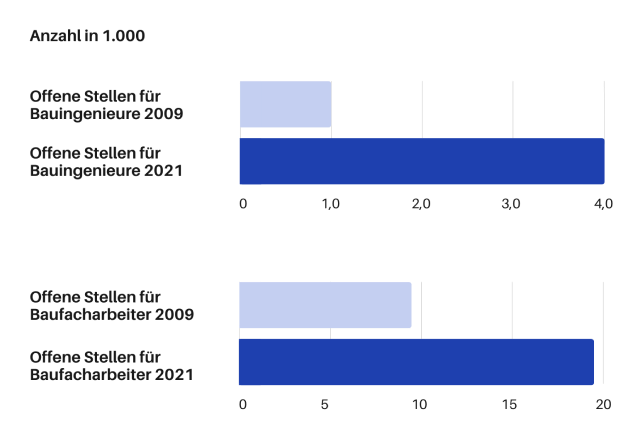
The number of open positions for civil engineers nearly quadrupled between 2009 and 2021, while those for skilled construction workers more than doubled.
What causes the skilled labor shortage in the construction industry?
The construction industry faces numerous challenges that intensify the shortage of qualified skilled workers. A significant factor is demographic change. As older, experienced professionals retire, there is a lack of a sufficient number of young talent ready to step into their shoes. In addition, many of these qualified workers are lured away to other sectors or abroad by more attractive salary offers or other working conditions.
Furthermore, training programs lag behind the requirements of the modern construction industry, meaning that not enough skilled workers are trained with the necessary skills and knowledge. Finally, the image of the construction trade also plays a role. The construction trade struggles with the perception of tough and physically demanding working conditions, which deters many potential talents and leads them to choose other, seemingly more attractive industries.
And what consequences does the skilled labor shortage have for the construction industry?
The shortage of qualified skilled workers in the construction industry triggers a chain of negative effects. Delayed construction projects become the norm, which not only affects the schedule but also drives up construction costs. Quality defects accumulate as the lack of expertise leads to errors and oversights. On a larger scale, the skilled labor shortage weakens the competitiveness of companies and inhibits innovation, as less expertise is available for advanced construction projects. In addition, existing employees feel growing pressure: they often have to work overtime and carry a greater burden to close the gaps.
Solutions and Measures
There are various starting points and measures to tackle the problem of the skilled labor shortage in the construction industry and ensure a more stable future for the sector:
1. Win over the next generation!
Nowadays, the construction industry’s focus is increasingly on recruiting young talent rather than customers. To attract the next generation to the construction industry, it is essential to inspire them through well-founded, practice-oriented training. Cooperations with schools and other educational institutions give construction companies the chance to identify and nurture future talent early on.
A contemporary image, shaped by the use of digital tools, is crucial to appeal to the tech-savvy generation. The younger generation expects a progressive working environment. It would therefore be wise to replace outdated and labor-intensive workflows, for example in documentation, with digital solutions. Involving young employees in the selection and implementation of these digital tools can accelerate the modernization process. Open communication about such modern approaches makes the construction industry even more appealing to young talent.
2. Digitization as an opportunity: software in construction
Advancing digitization offers enormous opportunities for the construction industry. By using software solutions, many processes can be automated and made more efficient, relieving the burden on skilled workers. Our software “Bausicht” is one of many examples here: with the help of digital access control and attendance tracking, automated document management and digital construction logistics, not only are processes simplified, but valuable resources are also saved. Through such automation, skilled workers can focus on other value-adding activities while routine tasks are handled by the software.
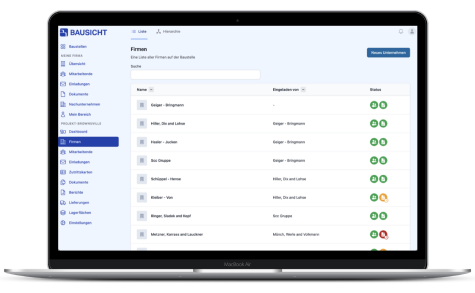
See for yourself and test it free for 14 days!
3. Optimize working conditions and let your employees share in your success!
The construction industry is currently experiencing an abundance of orders. While this may seem advantageous for business, it can lead to overtime and stress for employees. It is crucial that employees feel valued and not exploited. One way to show appreciation could be direct profit-sharing or expanding decision-making autonomy. Regular feedback and the implementation of employee suggestions are also valuable.
At the same time, the construction industry often struggles with the image of hard work and demanding working conditions. Reshaping these conditions, for example through investments in modern work equipment, safety gear, flexible working hours and health promotion, can make the industry more attractive to skilled workers. A supportive working environment not only attracts new talent but also helps retain existing employees.

4. Upgrade your image
The image of the construction trade is crucial for attracting young talent. To renew the outdated picture, campaigns are needed that emphasize the attractiveness of the sector. Success stories and career opportunities should take center stage. A cooperation with suitable media partners reinforces this message.
Quality and efficiency are also key to positioning yourself as an attractive employer. In the complex construction industry, digital solutions help optimize workflows. By identifying and eliminating bottlenecks with suitable software solutions, your company presents itself as future-oriented. It is essential to communicate this progress publicly and thus promote a modern image.
5. Consider employing qualified international skilled workers
In times of skilled labor shortages, looking beyond national borders is becoming increasingly important. By specifically recruiting international skilled workers, the construction industry can benefit from a broad pool of talent and expertise. However, this requires companies to be open to international cooperations and partnerships and to actively strive to build networks and relationships. Another important step is to inform yourself about the current legal requirements for employing foreign workers, such as their residence status. Get in touch with your local employment agency and clarify any open questions.

Take Your Knowledge to the Next Level!
Deepen Your Knowledge
Discover informative insights into the construction industry through our blog posts while we take care of your request.

Expert Knowledge
Copying Access Cards? Why MIFARE Classic Is a Security Risk on Construction Sites

Christopher Sura

Expert Knowledge
Data Protection - Access Control on the Construction Site
Christopher Sura

Expert Knowledge
AI in the Construction Industry: 2024 Forecast

Tristan Ratz
See Bausicht in Action?
Schedule a no-obligation demo appointment to learn how Bausicht can save you time and money in the future.